
ESRS S2 Workers in the value chain

S2-1 - Policies connected with value chain workers
The Enea Group has not implemented human rights policy regarding value chain work because these issues are regulated by the Code of Conduct for Contractors of the Enea Group, which defines fundamental expectations of the Enea Group about all Contractors.
The expectations concern compliance of their activity with generally applicable laws, market and ethical standards. The Code of Conduct for Contractors of the Enea Group is an element of the Compliance System in the Enea Group, which is made up of internal regulations which define values and principles of conduct adopted in the Group. The document was adopted with a resolution of the Enea S.A. Management Board, whereas the operational responsibility for implementing its provisions is vested in the Director of the Company’s Legal and Compliance Department.
The Code of Conduct for Contractors refers to the Code of Ethics of the Enea Group and is based on the values adopted in the Enea Group: integrity, responsibility, work security and competence. The values are treated as a commitment to contractors as well as the expectation that they will comply with laws, market and ethical standards. The Code of Conduct for Contractors contains precise regulations of Enea Group’s expectations in terms of the contractors’ compliance with law, protection of natural environment, prevention of corruption and conflict of interest, and operation in accordance with fair competition principles.
The Code of Conduct for Contractors emphasizes the necessity to protect human rights, work security and protect rights and freedoms by entities cooperating with the Enea Group’s companies.
Every contractor undertakes to:
- respect human rights and dignity of every person,
- make efforts to ensure that all its employees treat one another with respect,
- respect fundamental labor rights,
- ensure fair working conditions and pay,
- refrain from hiring persons under the minimum legally permitted age in the respective country as defined in international standards,
- refrain from using forced labor and refrain from cooperating with subcontractors ever found to have benefited from the use of labor performed by children below the minimum age adopted in the respective country and defined in international standards,
- refrain from discriminating employees both at the stage of recruitment and during employment,
- ensure safe working conditions for its employees, in compliance with the prevailing OHS regulations and manage any irregularities in the area, monitor and remove them on an ongoing basis,
- ensure freedom of association without fear of intimidation or pressure of any kind and engage in social dialog,
- deliver only such products and services which satisfy international quality and security standards.

Although the Code does not explicitly address the issue of human trafficking, the scope of the Code and references to national law and international standards also prohibit such activities.
Business partners participating in the Enea Group’s procurement processes submit statements confirming that they have read the Code of Conduct for Contractors and undertake to comply with the principles set forth therein in all business relationships with the companies from the Enea Group. They also confirm this in detail in agreements they enter into with the Enea Group. The Enea Group does not enter into contracts with entities that do not accept the above requirements. In addition, if any violations of the Code are identified, the contractor is asked to take immediate action to investigate and remedy the situation. The Enea Group companies reserve the right to impose appropriate sanctions on the relevant contractor, including terminating their business cooperation.
The Enea Group Code of Conduct for Contractors was not prepared on a basis of the UN Guiding Principles on Business and Human Rights; however, the Group believes that its provisions are consistent with the values laid down in these international regulations (including respect for the dignity and rights of every human being, respect for fundamental employee rights, etc.). Furthermore, issues of work safety have been formalized as the Instruction for Supervising Work Safety of Contractors in the Enea Group. In 2025, there were no cases of non-compliance with the UN Guiding Principles.
The Code of Conduct for Contractors of the Enea Group is addressed to all contractors of the Enea Group. The document is publicly available and has been published on the company’s website and a link to it is provided in procurement documentation.
The Code of Conduct for Contractors is a component of the Enea Group’s Compliance system and individuals who start working for Enea Group companies get to know its content during the onboarding process. Other employees take part in regular training sessions to remind them of the principles of the regulation.
The Group provides value chain employees with special channels, given at enea.pl, through which they may report actions inconsistent with provisions of the Code of Conduct for Contractors. Detailed information on the channels and protection of whistleblowers can be found in disclosure G1-1 of the present Report.
S2-2 – Processes for engaging with value chain workers about impacts
In 2025, the Enea Group did not hold any active dialog with any value chain workers. In connection with this, their opinions did not impact any decisions or actions related to the management of actual or potential impacts. Although no comprehensive process for engaging with employees and their representatives in the value chain has been implemented, the Group consistently develops and strengthens cooperation in the area of occupational health and safety. The top positions with operational responsibility for ensuring that such cooperation takes place are the directors of departments that work directly with external entities in the supply chain or other individuals who sign contracts.


S2-3 – Processes to remediate negative impacts and channels for value chain workers to raise concerns
In the Enea Group all value chain workers may – through special channels – report, among other things, violations of the Code of Conduct for Contractors pertaining to the OHS and human rights. Detailed information on this and on the protection of whistleblowers can be found in disclosure G1-1 of the present Report. As mentioned above, if any violations of the Code are identified, the contractor is asked to take immediate action to investigate and remedy the situation. The Enea Group companies reserve the right to impose appropriate sanctions on the relevant contractor, including terminating their business cooperation.
The organization does not require its business partners to provide its employees with information about available channels for reporting breaches of the Code of Conduct for Contractors, does not monitor their effectiveness or assess whether value chain workers are aware that such a mechanism operates. Information on the manner of reporting violations is nevertheless publicly available at the Enea Group’s website. At LW Bogdanka S.A., where the Code of Conduct for Suppliers is also in force, another channel for reporting breaches has been added – contact boxes with the word “Breaches” on them have been installed for value chain workers doing work in the area of the company.
S2-4 – Taking action on material impacts on value chain workers, and approaches to managing material risks and pursuing material opportunities related to value chain workers, and effectiveness of those actions
In the Enea Group, one management process for the OHS area operates, as described in detail on section S1-1 of this Report. Actions relating to the OHS are planned on the basis of an analysis of the management system and accident data. Among actions taken in 2025 to manage material impacts on value chain workers the most important was the implementation of the Instruction for Supervising Work Safety of Contractors in the Enea Group. The Instruction defines minimum rules of supervising contractors’ compliance with OHS, fire and environmental protection regulations. The Instruction helps build and strengthen a safety culture within contractor companies working on behalf of the Enea Group or on premises owned by the Group. Activities are monitored by collecting information about accidents of value chain workers from contractors. The process of collecting this information was initiated during the reporting period and is currently being further developed and made systematic. The Group does not implement corrective measures in the event of accidents of value chain workers.
The Group does not currently conduct audits of its business partners. However, it strives to prevent any potential adverse impacts on value chain workers by requiring acceptance of the Code of Conduct for Contractors, as described above. From the very beginning, the rules of cooperation and the consequences of violating them are clearly defined. In addition, the Group plans to update its Procurement Policy in the near future to incorporate issues related to a sustainable supply chain, as well as to implement a two-stage verification process for key business partners.
In the reporting period, no serious human rights issues or incidents at the upstream and downstream value chain were reported.
The completed and planned actions do not require any considerable resources, including operating expenses.

S4-5 – Targets related to managing material negative impacts, advancing positive impacts, and managing material risks and opportunities
In 2025, the Enea Group prepared and implemented the Enea Group Sustainability Strategy to 2035, adopting the strategic goal of implementing sustainable supply chain principles and development of cooperation with suppliers. The planned actions include updating the existing procurement policy to incorporate sustainable supply chain issues and conducting a review of key suppliers that takes into account sustainable supply chain principles, including respect for human rights. When setting the goal, stakeholders were not involved.
The percentage of key suppliers (contractors) covered by a two-stage verification process, which is in line with the sustainable supply chain principles [%]
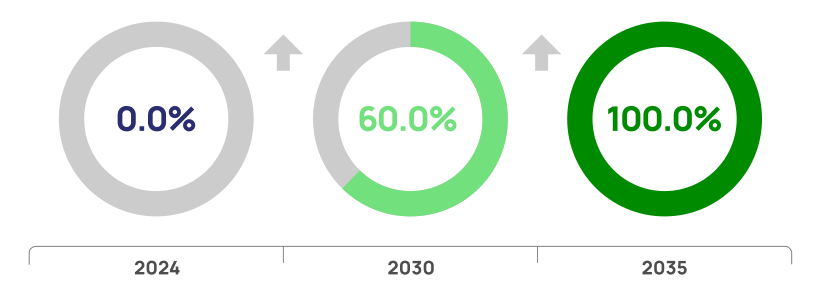
The percentage of key suppliers (contractors) covered by a two-stage verification process, which is in line with the sustainable supply chain principles is the number of key suppliers covered by a two-stage verification process in line with the sustainable supply chain principles relative to the number of all key suppliers of the Group. The key suppliers will be indicated after mapping and categorizing suppliers. The Group has not started the supplier verification process yet.
With regard to workplace accidents involving value chain workers, the Group has not set specific quantitative targets; however, it has outlined initiatives in this area in the Strategy.
The table below presents material topics with the impacts, risks and opportunities identified and assigned policies, actions or targets. They are described in more detail in the following sections of the chapter.