ESRS G1 Business conduct

G1-1 Business conduct policies and corporate culture

The corporate culture of the Enea Group is built on the foundation of the values defined in the Enea Group Code of Ethics, as well as on compliance and HR frameworks. The core values: Integrity, Competence, Responsibility, and Safety, serve as the benchmark for expected employee behavior in all stakeholder interactions. The Enea Group Code of Ethics is an integral component of the Compliance system, providing a set of values and principles that foster enduring and transparent relationships with all stakeholders. All Enea Group companies adhere to the values set by the Code in their daily internal operations and external engagements.

According to the principles adopted in the Enea Group, each employee should be familiar and observe the provisions of the Code, which shape individual attitudes and the overall organizational culture. The documents also shows how to behave in situations that are not always regulated by laws. Knowledge of provisions of the Enea Group Code of Ethics is transmitted to employees during training sessions, which are described in more detail in the following paragraphs.

Values and principles of the Code as well as ways of preventing breaches and paths of responding to such breaches by the Enea Group are implemented through internal regulations of the organization and normative acts of the companies such as the Enea Group Compliance Policy, Rules for Offering and Receiving Gifts in the Enea Group, Procedure for Reporting Breaches and Protecting Whistleblowers in Enea S.A. and similar procedures in the subsidiaries.

The policies focusing on, among others, corporate culture and ethics, were made available on the Group’s Intranet and in the Document Libraries of Enea S.A. and its subsidiaries. In addition, the company’s public website contains brochures on the Enea Group Code of Ethics and the Enea Group Code of Conduct for Contractors.

Organizational culture is further reinforced through physical and e-learning training sessions covering ethics, legal compliance, anti-fraud measures, and occupational safety. The Company uses internal communication, employer branding initiatives, and social and sponsorship activities to reinforce desired behaviors and support employee engagement.

The assessment of organizational culture is based on employee opinion and engagement surveys, as well as the analysis of reports from whistleblowing systems. The results of these assessments are used to update policies, training programs, and communication strategies, enabling the continuous refinement of the organizational culture.

The implementation of the Enea Group Sustainability Strategy will contribute to the evolution of corporate culture through initiatives linked to the compliance system and supplier relations.

The Enea Group has implemented a comprehensive suite of policies that create clear standards for business conduct. These documents were developed as part of the evolving compliance management system and were adopted by the Enea S.A. Management Board These regulations are binding for all employees and apply to all relationships with business partners.

The key policies governing business conduct include:

  • Enea Group Compliance Policy,
  • Enea Group Code of Ethics,
  • Code of Conduct for Contractors of the Enea Group,
  • Third Party Risk Management System in the Enea Group
  • Rules for Offering and Receiving Gifts in the Enea Group,
  • procedures for reporting breaches in individual companies, for example the Procedure for Reporting Breaches and Protecting Whistleblowers in Enea S.A.

The adopted regulations address key risks existing in the compliance area, related to corruption, unfair market practices, conflicts of interest, and the legal, financial, or reputational risks arising from non-compliance.

These policies encompass the Enea Group and apply to both its own operations and key components of its value chain, with a particular focus on relationships with employees, contractors, and business partners. These regulations are addressed primarily to the employees, associates, and board members of Enea Group companies, as well as to suppliers, contractors, business partners, customers, and other external stakeholders. They govern the principles of fair communication, fraud prevention, and the protection of consumer rights. The Code of Conduct for Contractors of the ENEA Group also specifies the procedures to be followed in the event of a breach of its provisions.

All policies are available on the intranet of Enea S.A. and its subsidiaries. If a specific subsidiary has no intranet site, the policies are distributed to employees by e-mail. Employees participate in regular training sessions and receive information that allows them to understand and observe the applicable rules. The wording of the documents containing breach reporting and whistleblower protection procedures was consulted with trade unions. External stakeholders may access dedicated brochures available on the www.enea.pl website.

Enea S.A. also maintains a structured system for overseeing policy implementation, which includes the review of draft documents by legal counsel, regular reviews and updates of existing regulations, the analysis of reported violations, and audits and inspections. The Management Board of Enea S.A., the parent company, adopts policies and regulations for the entire Group based on the ENEA Group Code and the articles of association of the subsidiaries.

The Enea Group has implemented procedures for reporting violations and the rules for raising ethical and legal concerns.

All employees, irrespective of their position or function, are responsible for complying with the law and internal regulations, with particular emphasis on the Enea Group Compliance Policy and the Enea Group Code of Ethics. In the event of questions or doubts concerning the application of generally applicable provisions of law or internal regulations during the performance of professional duties, employees contact their supervisor or the Company’s legal function through provided communication channels. Questions or doubts of an ethical nature, or those related to compliance with the Code of Ethics and the Compliance Policy, should be directed through available communication channels: by contacting a supervisor, the Compliance Officers of the respective companies, the Enea Group Compliance Officer, or other personnel responsible for the Compliance area.

The Enea Group has not implemented a separate policy specifically dedicated to anti-corruption or anti-bribery. However, these issues are regulated in detail in, among others, the Enea Group Compliance Policy, the Enea Group Code of Ethics, the Enea Group Code of Conduct for Contractors, the Procedure for Reporting Breaches and Protecting Whistleblowers in Enea S.A., and similar documents in effect in the subsidiaries, as well as in the Rules for Offering and Receiving Gifts in the Enea Group.

Additionally, as an example, LW Bogdanka S.A. adopted its own Anti-Corruption Policy, which identifies legal and ethical standards which make it possible to conduct economic activities in a responsible and transparent manner. Issues of corruption are also included in the Lubelski Węgiel Bogdanka Group’s Code of Ethics, the Guidelines on Offering and Receiving Gifts at Lubelski Węgiel Bogdanka and the Compliance Policy of Lubelski Węgiel Bogdanka.

Within the Enea Group’s anti-corruption management framework, all employees, regardless of position or form of employment, are deemed to be potentially exposed to corruption risks. We distinguish between two primary categories of workers: manual and non-manual. Non-manual workers, who perform office or decision-making functions, or hold procurement and contracting roles, are more exposed to corruption risk because they make financial decisions, conduct negotiations with contractors, take part in tender processes, and influence the performance of agreements.

The Enea Group provides business conduct training to all employees. These matters are also a core component of orientation training for individuals joining the organization.

Protection of whistleblowers

The Enea Group has implemented internal reporting procedures as required by the Whistleblower Protection Act of 14 June 2024. Reports received by the organization are analyzed efficiently, independently, and impartially. In accordance with the Act, the timeframe for providing feedback on a report is up to three months from the date of confirmation of receipt.

The Enea Group guarantees that individuals conducting investigations remain entirely independent of the management structures involved in a given case. This independence is maintained by excluding Commission members in specific situations and by ensuring oversight of either the Management Board or the Supervisory Board, depending on the position of the person named as the perpetrator of the violation. In accordance with the whistleblower protection procedures, developed on the basis of the Act and implemented across the subsidiaries, the Compliance Committee in each company registers the reports on an ongoing basis in the company’s Register of Internal Reports and initiates appropriate action.

All Enea Group companies provide confidential reporting channels, including those ensuring anonymity for the whistleblower. Whistleblowers may report violations orally, during a face-to-face meeting organized upon the whistleblower’s request within 14 days of its receipt, or in writing, including by mail, to designated mailing addresses, or through a dedicated system provided by an external vendor.

In December 2025, the Management Board of Enea S.A. adopted a resolution introducing changes to the Compliance and whistleblower protection framework (which came into effect on 1 January 2026). Consequently, the ENEA Group Compliance Policy and the Procedure for Reporting Breaches and Protecting Whistleblowers in Enea S.A. have been updated.

In accordance with the aforementioned Procedure, no retaliatory actions, or attempts or threats of retaliation may be taken against a whistleblower, including but not limited to:

  • refusal to establish an employment relationship;
  • notice of termination or summary dismissal;
  • failure to enter into a definite term or indefinite term contract after termination of a probationary period employment contract, failure to renew a definite term employment contract or failure to enter an indefinite term employment contract after a definite term employment contract is terminated – where the whistleblower had a reasonable expectation of such a renewal;
  • reduction in remuneration;
  • withholding of promotion or being bypassed for promotion;
  • omission from or reduction of employment-related benefits other than salary;
  • demotion to a lower position;
  • suspension from professional or official duties;
  • reassignment of the whistleblower’s current duties to another employee;
  • unfavorable change to the place of work or working schedule;
  • negative performance evaluation or negative employment reference;
  • imposition or application of a disciplinary measure, including a financial penalty or similar sanction;
  • coercion, intimidation, or exclusion;
  • mobbing;
  • discrimination;
  • unfavorable or unjust treatment,
  • withholding participation in or omission from selection for professional qualification training;
  • unjustified referral for medical examinations, including psychiatric evaluations, unless separate regulations specifically provide for such a referral;
  • actions aimed at impeding future employment within a given sector or industry, based on an informal or formal sectoral or industry arrangement;
  • causing financial loss, including economic loss or loss of income;
  • inflicting other non-material damage, including the infringement of personal rights, particularly the whistleblower’s reputation;
  • termination of a contract to which the whistleblower is a party, specifically contracts regarding the sale or delivery of goods or the provision of services, as well as withdrawal from or summary termination of such an agreement;
  • imposition of an obligation or the refusal to grant, restriction of, or revocation of a right, in particular a license, permit, or relief.

The prohibition of retaliatory actions applies not only to in reference to the whistleblowers but also:

  • individuals who helped to make the report;
  • individuals associated with the whistleblower;
  • legal entities or other organizational units helping or associated with the whistleblower, particularly those owned by or employing the whistleblower.

Taking retaliatory action against whistleblowers or the entities specified in Art. 3 of the Whistleblower Protection Act, as well as preventing or significantly impeding the submission of a report or the unlawful disclosure of a whistleblower’s identity by the Company, including members of its corporate bodies and other employees, constitutes a grave breach of fundamental employee duties and a violation of the Enea Group’s core values and ethical principles as defined in the Enea Group Code of Ethics.

In 2025, the Enea Group conducted e-learning sessions on anti-corruption, both as periodic training for current staff and as part of the orientation process for new employees. Additionally, an educational campaign on whistleblowers was organized for Group employees as well as external stakeholders. Both initiatives support the implementation of the Enea Group’s anti-corruption and whistleblower protection policies and address the impacts and risks identified in these areas.

The Enea Group does not engage in activities that directly influence the political or legislative actions of administrative bodies. Its activity in this area focuses on active participation in ongoing legislative processes, mainly through industry organizations and associations (e.g., PKEE, TGPE, PTEC). Accordingly, the Group has not established a specific policy applicable directly to political engagement, and there are currently no plans to develop one. Risks identified in the political engagement area are monitored and managed by the Group in accordance with the Enea Group’s Methodology for Managing ESG Risks and Opportunities.  Membership in industry organizations and associations fosters the development of relationships with public administration bodies and industry representatives, which has been identified as a significant opportunity in this area. In 2025, the Enea Group engaged, either directly or through industry organizations, in legislative processes in Poland associated, among other things, with the amendment of the Energy Law and the Act on Renewable Energy Sources, and at the European level: the European Climate Law and the EU Heating and Cooling Strategy.

In 2025, the ICT and Security Strategy was implemented, setting out the key strategic directions for 2026-2028, i.e.:

  • IT systems supporting business,
  • Operational excellence based on automation,
  • Data-based organization,
  • Effective security management,
  • Modern ICT environment,
  • Active management of digital competencies.

The key assumption of the strategy in the area of security is to achieve rapid change in the maturity of ICT (Information and Communication Technology) and OT (Operational Technology) cybersecurity, while simultaneously elevating the systemic and physical protection of facilities vital to the Group’s operations, with particular emphasis on critical infrastructure and infrastructure subject to mandatory protection. As part of the implementation of the Strategy, 23 strategic initiatives have been prepared for the security area. They will affect processes and standards for ICT and OT security, business continuity, physical security, and supply chain integrity. The Management Board of Enea S.A. is responsible for the adoption and oversight of the implementation of the Strategy.

The development of the Strategy was preceded by workshops involving representatives from key Enea Group subsidiaries, and its adoption was communicated to employees during the Q3 2025 earnings conference. The Strategy was developed based on the NIST (National Institute of Standards and Technology) Cybersecurity Framework and ISO/IEC 27001 standards.

In 2025, an ICT cybersecurity audit was also conducted at Enea Centrum, as well as an OT cybersecurity audit across ten Group companies of strategic importance to Poland’s energy security. The objective of these audits was to determine the current level of maturity of cybersecurity processes and the cybersecurity organization within the Group based on international NIST standards. The audit results were used to develop a roadmap for the period from 2026 to 2028, designed to elevate the maturity of ICT and OT cybersecurity in the Group. This roadmap was formally adopted by a resolution of the Enea S.A. Management Board.

To facilitate the Group’s effective digital transformation, the security area was reorganized in 2025. Cybersecurity functions were transferred to Enea Centrum and are now delivered as shared services within the Enea Group. This organizational change was coupled with the elevation of telecommunications and information security competencies in the Group and is aimed toward the ultimate centralization of ICT and OT cybersecurity monitoring processes. Additionally, the Physical Security Division was created in Enea Centrum, which should address the Group’s needs for improving facility protection standards, with particular consideration of critical infrastructure and infrastructure subject to mandatory protection. These changes are aimed at improving the maturity of the security framework.

At the same time, a significant shift occurred in the information security management area: information processed within ICT systems is now subject to systemic protection. In 2025, a DLP (Data Loss Prevention) system was implemented, which monitors data flows across the Group’s IT channels and detects violations of the security policy. This is a modern solution, which effectively strengthens information protection in the Group.

Based on the principle that the human element is the most critical component of the security ecosystem, the Enea Group has launched the CyberBezpieczni training program. The program will take three years and is addressed to 10 thousand employees who have access to the corporate network. The program utilizes professional IT tools and provides continuous training updated in monthly cycles. Its objective is to build awareness, expand employee cybersecurity knowledge, and instill proper responses to cyber threats.

The total cost of implementing security initiatives over the three-year period is estimated at over 70 million PLN.


The Enea Group has in place the Personal Data Protection Policy, which serves as the framework for collecting information on incidents, defined as all events whether or not they are ultimately classified as a breach of regulations.

In 2025, the Enea Group recorded 131 cases of personal data protection breaches (392 breaches in 2024). The majority of these presented a negligible risk to the rights and freedoms of the data subjects. There were only 3 instances, in which the risk level was higher. These breaches were reported to the President of the Personal Data Protection Office in accordance with legal requirements. These incidents occurred at Enea Centrum, Enea Operator, and Miejska Energetyka Cieplna Piła.

G1-2 Management of relationships with suppliers

Enea Group’s business relationships with contractors are based on applicable laws, internal regulations, and international standards, including the ten principles of the UN Global Compact. The key document governing these relationships is the Code of Conduct for Contractors of the ENEA Group, which outlines the Group’s key expectations for contractors regarding compliance of their actions with applicable laws, market standards, and ethical norms. The Code also reflects the Group’s core Values and Principles of Conduct. Its purpose is to establish long-term, fair, and transparent business relationships based on mutual respect and partnership. The document details the Enea Group’s expectations regarding legal compliance, human rights, occupational safety, environmental protection, fair competition, anti-corruption, conflict of interest, whistleblowing, as well as the consequences of non-compliance. These terms of cooperation are provided to and accepted by contractors during the contracting stage.

Measures to prevent payment delays are governed by the Enea Group Procurement Policy, managed by the Procurement Department Director at Enea Centrum. The policy defines the rules for managing payment terms across the subsidiaries (with the standard payment term being 30 days).  To support this Policy, the Group has implemented a practice of providing Management with periodic reports on identified payment delays within individual organizational units, which enables the monitoring of root causes and the implementation of preventive measures at the local level. At the same time, the Enea Group applies solutions that allow a broad group of contractors to participate in procedures, such as, for example, transparent payment terms, split payments linked to the completion of specific project milestones. Preliminary market consultations with contractors are also a standard practice that ensures that the description of the subject of the contract and the tender conditions are prepared properly and that the principles of equal treatment and fair competition are maintained. So far the organization does not have in place any separate regulations for preventing delays in payments to SMEs, but according to the Sustainable Development Strategy such measures are planned.

The Enea Group Procurement Policy and the Rules and Regulations for Awarding Contracts in the Enea Group describe procurement procedures carried out in the Group. These documents require that objective selection criteria are used, the principles of fair competition and equal treatment are respected, and impartiality and objectivity of individuals conducting the proceedings are assured. Enea Group companies select contractors primarily based on non-price criteria, particularly emphasizing:

  • social aspects, including professional and social integration of the unemployed, the youth and the disabled,
  • environmental aspects, including energy efficiency of the subject of contract,
  • innovation.

The social and environmental criteria are defined based on the needs of a specific procurement procedure. A different approach in this area is taken by LW Bogdanka S.A., which does not consider social and environmental criteria when selecting a bid. Nevertheless, a bidder undertakes that its employees and sub-contractors working at the site or under the supervision of the company will comply with applicable laws, including those concerning human rights, labor laws, environmental laws and the provisions of the Code of Ethics of the Lubelski Węgiel Bogdanka Group.

Additionally, in December 2025, the Enea Group implemented a Third-Party Risk Management (TPRM) procedure. The verification of past cooperation with contractors is a core component of the Group’s risk analysis and serves, among other purposes, to determine the levels of credit limits. Mandatory verification applies to all suppliers being considered for contracts exceeding a specified materiality threshold. The purpose of this process is to mitigate financial, legal, and reputational risks, which supports the Group’s strategic objectives related to organizational resilience and security.

In order to maintain strong relations with suppliers while ensuring high service quality, in 2025 the Enea Group initiated efforts to broaden contractor verification for compliance with the Code of Conduct for Contractors of the Enea Group. These efforts include mandating adherence to the Code’s principles in all business dealings and expanding verification criteria to incorporate ESG factors. These actions resulted in an update to the Regulations of the List of Qualified Contractors. Additionally, work has commenced on the implementation of a digital platform for risk assessment (including ESG risks) in procurement processes, aimed at ensuring respect for the environment and human rights among contractors. The work mentioned above is scheduled for completion in 2026.

In addition to these initiatives, the Enea Group has developed and implemented the ESG Strategy, which defines targets to be achieved in the coming years and the specific actions required to achieve them.

Irregularities identified in supplier relations are subject to formal investigation procedures. In 2024, internal audits revealed irregularities in cooperation with suppliers. They concerned in particular irregularities in biomass procurement by Enea Elektrownia Połaniec. Furthermore, UOKiK is conducting proceedings regarding relations with business partners, specifically allegations of preferential treatment for certain entities during the grid connection of RES installations. Both matters are currently under investigation.

G1-3 Prevention and detection of corruption and bribery

The Enea Group has a zero-tolerance policy toward corruption and ensures that such practices do not influence decision-making.

The Group has in place procurement procedures, internal controls, and internal audit to minimize the risk of corruption incidents. Furthermore, adopted regulations strictly prohibit the offering, giving, or accepting of material or personal benefits which, by their nature, value or situational context, could affect the objectivity and integrity of the performance of professional duties. Any employee and any other person acting on behalf of a Group company who learns about corrupt practices is able to report the violation through confidential and anonymous internal reporting channels.

All reports of potential corruption are reviewed in accordance with the procedures for reporting breaches and protecting whistleblower adopted by the respective companies. Compliance Committees have been established in Group companies to conduct investigations; these commissions are independent and separate from the management structures involved in the case. The Commissions act as advisory bodies responsible for establishing all the circumstances of a report, analyzing risks, and recommending corrective actions. Commission proceedings are treated as confidential. The Commissions provide the management boards with recommendations and regular statistics about the reports.

In cases where a report concerns a Commission member, the investigation is overseen by the President of the Management Board of the respective company. The Commission reviews the report without the participation of the member named in the report. If a report concerns a Management Board member, the Supervisory Board provides oversight of the investigative activities carried out by the Compliance Committee.

Enea Group employees are categorized as manual or non-manual. Non-manual workers, who perform office or decision-making functions, or hold procurement and contracting roles, are more exposed to corruption risk because they make financial decisions, conduct negotiations with contractors, take part in tender processes, and influence the performance of agreements. Mandatory anti-corruption training (periodic e-learning sessions) is addressed to these employees. The curriculum includes, among other things: corruption-related offenses, liability of a collective entity, the benefits of legal compliance, and reporting of corruption in the Enea Group. At Enea S.A., members of the Management Board have access to standard anti-corruption training for employees. Additionally, a dedicated session for Enea S.A. Management Board members was held in December 2025.  These training programs do not currently cover Supervisory Board members.

The Group recognizes that all employees, including manual workers, are potentially exposed to corruption risks. Consequently, it applies preventive measures tailored to those with limited access to digital tools. These include:

  • information campaigns in work establishments (posters, printed materials, internal messages) that are part of the #Enea Jest Fair information campaigns https://www.enea.pl/jestem-fair,
  • information campaign on reporting breaches and whistleblower protection,
  • provision of access to channels to report breaches, including corruption,
  • integration of ethical and anti-corruption topics into the onboarding process for newly-hired employees (in selected subsidiaries);
  • ongoing internal communications reinforcing current ethical standards;
  • periodic in-person training sessions organized within certain subsidiaries.

The operating model ensures that all employees have full access to information regarding anti-corruption principles and reporting channels, and the intensity of training activities is matched to risk levels.

All current and archived policies are accessible in the corporate intranet document library. Employees receive e-mail notifications regarding the adoption, modification, or repeal of any policy, including a brief description and the effective date.

The table below presents the percentage of functions at corruption risk covered by training programs, in 2024 and 2025, in the Enea Group.

Percentage of functions-at-corruption-risk covered by training programs 2024 2025
Percentage of functions-at-corruption-risk covered by training programs 99.47% 99.77%
Percentage of functions-at-corruption-risk covered by training programs 2024 2025
Percentage of functions-at-corruption-risk covered by training programs 99.47% 99.77%

G1-4 Incidents of corruption or bribery

In 2025, there were no court proceedings which would rule that companies from the Enea Group breached anti-corruption and anti-bribery laws. Therefore, no fines were imposed in connection with such laws. Any actions taken by the Group to address breaches in procedures and standards of anti-corruption and anti-bribery are described above in this chapter.

Data about incidents of corruption and bribery come from registers of breaches kept by the companies in accordance with the procedures for reporting breaches and protecting whistleblowers. For some companies, data are obtained from monthly reports of incidents in the Compliance area. Data about court proceedings come from registers of court cases maintained by the companies. The measurement of this metric has not been validated by an external body.

G1-5 Political influence and lobbying activities

In the reporting period, the Enea Group did not conduct any activity related to exerting political influence. The Group engaged in lobbying activities aimed at shaping the regulatory environment in areas critical to the energy sector.

List of associations Companies Key topics of the lobbying activity Link to IRO
Polish Electricity Committee (PKEE) Enea S.A., Enea Elektrownia Połaniec European Climate Law – Advocating for the inclusion of national differences and flexibility mechanisms in setting the 2040 decarbonization target; expanding consultations and analyses regarding target setting Greenhouse gas emissions, Risk of use of the technologies that will be phased out due to climate change regulations
Union of Entrepreneurs and Employers (ZPP) Enea S.A. Support for the provisions of the act freeing up investments in on-shore wind power generation Development of RES and new business lines
Energy Trading Association (TOE) Enea S.A. Reducing the obligations of energy retailers regarding the submission of new tariff applications for Q1 2025.
Polish Association of Listed Companies (SEG) Enea S.A. Streamlining reporting obligations and reducing administrative burdens.
Association of Polish Power Sector Employers (ZPEP) Enea S.A. Influencing the development of economic and social legislation to support the harmonious development of the energy sector and labor relations, while considering the rights and interests of member employers. Redefining of collective bargaining agreements, Effective trade unions
Polish Association for Electricity Transmission and Distribution Enea Operator Participating in the shaping of national energy policy and energy law; promoting new solutions for the power transmission and distribution subsectors; supporting technology changes and the implementation of new technologies in the power industry. Strengthening of security and reliability of electricity supply, Modernization of the distribution network and support for the development of RES, Risk of inability to effectively manage RES generation sources connected to the distribution network, Risk of delays and limitations in connecting new renewable energy sources to the distribution grid
European Distribution System Operators (E.DSO) Enea Operator Active representation of the European electricity distribution sector in activities envisaged in the instruments established by European Union institutions. Strengthening of security and reliability of electricity supply, Modernization of the distribution network and support for the development of RES, Risk of inability to effectively manage RES generation sources connected to the distribution network, Risk of delays and limitations in connecting new renewable energy sources to the distribution grid
EU DSO Entity Enea Operator Collaboration with European Union institutions to support the development of an integrated electricity market; supporting data management, cybersecurity, and data protection in cooperation with relevant authorities. Strengthening of security and reliability of electricity supply, Modernization of the distribution network and support for the development of RES, Risk of inability to effectively manage RES generation sources connected to the distribution network, Risk of delays and limitations in connecting new renewable energy sources to the distribution grid
Polish Power Plants Association (TGPE) Enea Wytwarzanie, Enea Elektrownia Połaniec Advocating for the restoration of the mandatory exchange clearing for electricity.
Polish Heating Sector Chamber of Commerce MEC Oborniki, PEC Piła Preparation of a report and opinions regarding the transition of the district heating sector in Poland Greenhouse gas emissions, Risk of use of the technologies that will be phased out due to climate change regulations
List of associations Companies Key topics of the lobbying activity Link to IRO
Polish Electricity Committee (PKEE) Enea S.A., Enea Elektrownia Połaniec European Climate Law – Advocating for the inclusion of national differences and flexibility mechanisms in setting the 2040 decarbonization target; expanding consultations and analyses regarding target setting Greenhouse gas emissions, Risk of use of the technologies that will be phased out due to climate change regulations
Union of Entrepreneurs and Employers (ZPP) Enea S.A. Support for the provisions of the act freeing up investments in on-shore wind power generation Development of RES and new business lines
Energy Trading Association (TOE) Enea S.A. Reducing the obligations of energy retailers regarding the submission of new tariff applications for Q1 2025.
Polish Association of Listed Companies (SEG) Enea S.A. Streamlining reporting obligations and reducing administrative burdens.
Association of Polish Power Sector Employers (ZPEP) Enea S.A. Influencing the development of economic and social legislation to support the harmonious development of the energy sector and labor relations, while considering the rights and interests of member employers. Redefining of collective bargaining agreements, Effective trade unions
Polish Association for Electricity Transmission and Distribution Enea Operator Participating in the shaping of national energy policy and energy law; promoting new solutions for the power transmission and distribution subsectors; supporting technology changes and the implementation of new technologies in the power industry. Strengthening of security and reliability of electricity supply, Modernization of the distribution network and support for the development of RES, Risk of inability to effectively manage RES generation sources connected to the distribution network, Risk of delays and limitations in connecting new renewable energy sources to the distribution grid
European Distribution System Operators (E.DSO) Enea Operator Active representation of the European electricity distribution sector in activities envisaged in the instruments established by European Union institutions. Strengthening of security and reliability of electricity supply, Modernization of the distribution network and support for the development of RES, Risk of inability to effectively manage RES generation sources connected to the distribution network, Risk of delays and limitations in connecting new renewable energy sources to the distribution grid
EU DSO Entity Enea Operator Collaboration with European Union institutions to support the development of an integrated electricity market; supporting data management, cybersecurity, and data protection in cooperation with relevant authorities. Strengthening of security and reliability of electricity supply, Modernization of the distribution network and support for the development of RES, Risk of inability to effectively manage RES generation sources connected to the distribution network, Risk of delays and limitations in connecting new renewable energy sources to the distribution grid
Polish Power Plants Association (TGPE) Enea Wytwarzanie, Enea Elektrownia Połaniec Advocating for the restoration of the mandatory exchange clearing for electricity.
Polish Heating Sector Chamber of Commerce MEC Oborniki, PEC Piła Preparation of a report and opinions regarding the transition of the district heating sector in Poland Greenhouse gas emissions, Risk of use of the technologies that will be phased out due to climate change regulations

In 2025, no significant expenditures were incurred for membership in the organizations mentioned above.

Between February and November 2025, Michał Kempa served as a member of the Supervisory Board while concurrently holding the position of Department Director at the Ministry of State Assets. On 8 January 2026, Mr. Adam Grzebieluch was appointed to the Enea S.A. Supervisory Board, who at the same time holds a comparable position in public administration (Department Director in the Ministry of State Assets).

G1-6 Payment practices

Payment practices of the Enea Group

Payment deadlines 2024 2025
Average time for payment of an invoiced amount 25 days 26 days
Standard payment terms 30 days 30 days
Percentage of payments consistent with the standard terms 79.69% 69.45%
Percentage of late payments1 1.40%
1A representative sample without LWB has been used to calculate the ratio.
Payment deadlines 2024 2025
Average time for payment of an invoiced amount 25 days 26 days
Standard payment terms 30 days 30 days
Percentage of payments consistent with the standard terms 79.69% 69.45%
Percentage of late payments1 1.40%

At the end of the reporting period, there was 1 court proceeding pending against Enea Group companies for late payments, which was not resolved with a final and non-appealable judgment.

The Enea Group has the standard of a 30-day payment term, which is in effect for all supplier categories. Other liabilities were paid with other deadlines, among others: 7 days, 14 days or more than 30 days. The average payment term of an invoice was 26 days2. In order to increase the transparency of payment practices, an additional information was added to the metric, i.e. the percentage of late payments. This metric presents a broader context of the timeliness of payment, by adding data on actual payment delays to the information on the percentage of payments consistent with standard terms, regardless of whether the accepted payment term was shorter or longer than the standard term.


2 A representative sample of companies listed below was used to calculate this metric: Enea S.A., Enea Operator, Enea Trading, Enea Centrum, Enea Serwis, Enea Pomiary, Enea Oświetlenie, Enea Ciepło, Enea Nowa Energia, Enea Power&Gas Trading, Enea Elektrownia Połaniec, Enea Bioenergia, Enea Wytwarzanie and LWB. The companies included in the sample represent ten out of eleven companies with the largest sales revenues in the Group. The calculation of the metric has not been validated by an external entity other than the assurance provider.

ESRS 2 MDR-T Tracking effectiveness of policies and actions through targets

In 2025, the Enea Group adopted the Enea Group Sustainability Strategy to 2035. Among the stated strategic objectives, two of them refer to business conduct:

  • Objective 11. Implementation of the principles of a sustainable supply chain – the initiatives and actions planned under this objective address impacts and risks associated with building strong supplier relations while incorporating sustainability criteria. While a measurable objective has been adopted, reporting on progress will only be feasible in subsequent years. This objective was not consulted with external stakeholders. The objective aligns with the requirements set forth in the Code of Conduct for Contractors of the Enea Group.

The percentage of key suppliers (contractors) covered by a two-stage verification process, which is in line with the sustainable supply chain principles [%]

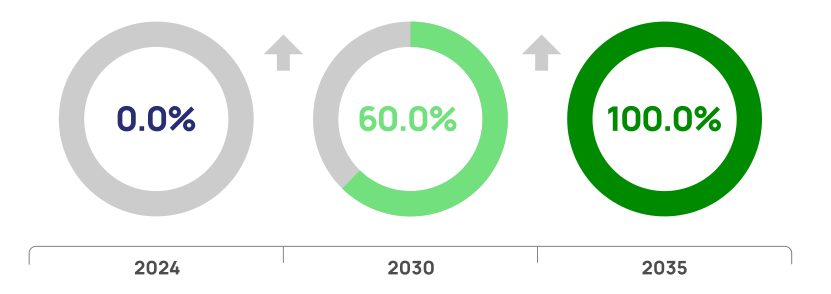
  • Objective 12. ESG Objective Achievement Rate (Measured by Strategic KPI Performance) – under this objective, progress monitoring for all objectives, including Objective 11 described above, will be conducted. The initiatives and actions planned under this objective encompass impacts, risks, and opportunities within the broader scope of ethics and corporate culture. The objective achievement rate for 2030 and 2035 has been set at 100%. This objective primarily fulfills the requirements of the Enea Group Compliance Policy and the Enea Group Code of Ethics.

Within the ICT and Security Strategy, 21 measurable strategic objectives have been adopted, but they remain classified due to the fact that cybersecurity within the energy sector is intrinsically linked to national security and critical infrastructure.

Material topic IRO Name Policies (P), Actions (A), Targets (T)
Ethics and corporate culture The use of codes of ethics and guidelines for working with business partners. P, A, T
Development of a sustainability strategy. A, T
Incidents of corruption. P, A
The risk of an increase in corruption incidents resulting from employees’ limited knowledge of anti-corruption measures. P, A
Implemented procedure for reporting breaches and protecting whistleblowers in the Enea Group. P, A
Political engagement Maintaining dialog with government entities. A
Risk of political instability and shifts in energy policy leading to inefficient operations of the Enea Group.
Risk of lobbying of the business interests of the energy industry over ESG benefits.
Development of relations with authorities and the industry. A
Supplier relations Supplier relations and Procurement Policy. P, A, T
Irregularities in relations with suppliers and business partners. P, A
Cybersecurity Risk of cyberattacks on systems and IT/OT infrastructure (ICT security). P, A, T
Material topic IRO Name Policies (P), Actions (A), Targets (T)
Ethics and corporate culture The use of codes of ethics and guidelines for working with business partners. P, A, T
Development of a sustainability strategy. A, T
Incidents of corruption. P, A
The risk of an increase in corruption incidents resulting from employees’ limited knowledge of anti-corruption measures. P, A
Implemented procedure for reporting breaches and protecting whistleblowers in the Enea Group. P, A
Political engagement Maintaining dialog with government entities. A
Risk of political instability and shifts in energy policy leading to inefficient operations of the Enea Group.
Risk of lobbying of the business interests of the energy industry over ESG benefits.
Development of relations with authorities and the industry. A
Supplier relations Supplier relations and Procurement Policy. P, A, T
Irregularities in relations with suppliers and business partners. P, A
Cybersecurity Risk of cyberattacks on systems and IT/OT infrastructure (ICT security). P, A, T
Search results